6 Years of Tool Budgets: Why Transparent Pricing Beat the Lowest Quote (and Why I Buy Bosch)
The lowest quoted price is usually the most expensive number you'll see all year.
I didn't learn that from a textbook. In my first year, I made the classic rookie error: I approved a quote because the line item was cheap, then spent a month dealing with the parts that weren't in the quote. That mistake cost us about $1,200 in rework and overtime. I don't make it anymore.
I've managed a six-figure tool budget across three facilities. I've audited our 2023 spending line by line. And I've watched a "cheap" purchase disappear into a maintenance black hole. The pattern is always the same: low upfront price, hidden follow-up costs, and a vendor who says "you should have asked."
Most Buyers Look at Price. I Look at What's Not Listed.
Most buyers focus on the sticker price and completely miss the things that aren't in the headline: whether the tool is a bare tool, whether the battery is included, whether the charger matches, and whether the blades will fit. The question everyone asks is "what's your best price?" The question I've learned to ask is "what's included in that price?"
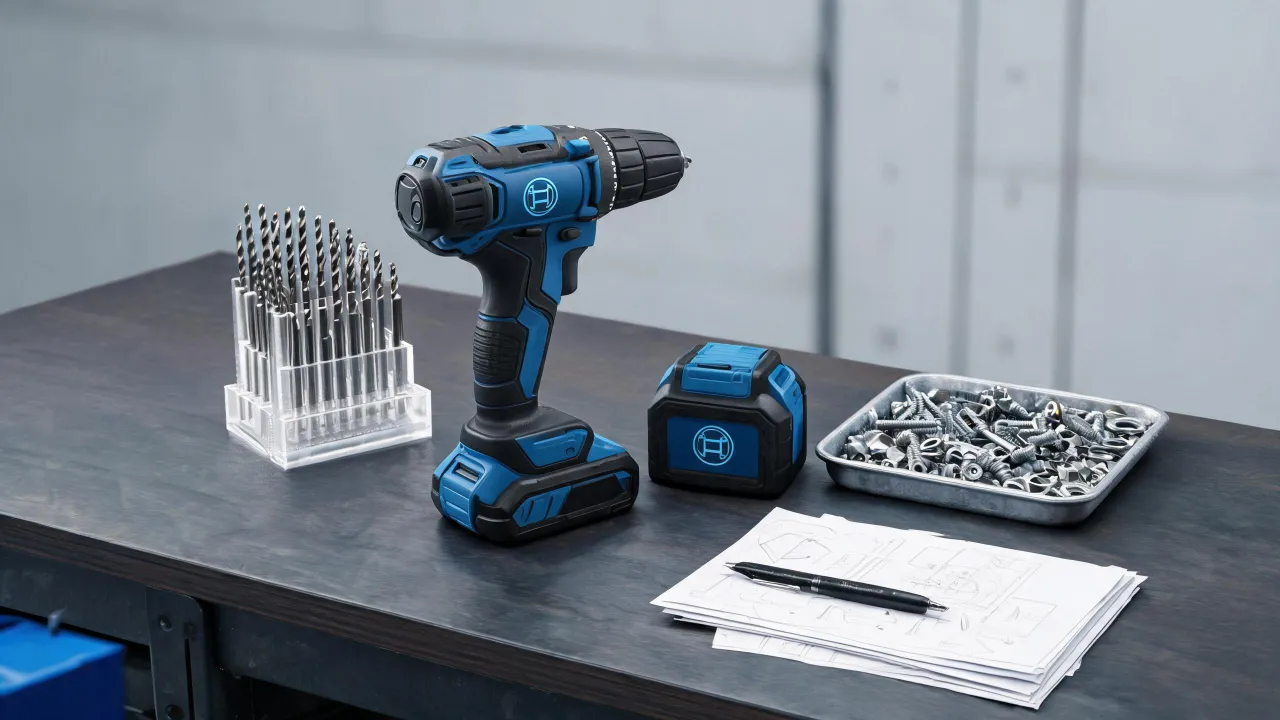
Take the Bosch 12V Max 3/8" drill driver bare tool. It can look expensive for a "small" drill until you realize it's a bare tool—no battery, no charger. That's not a trick; that's transparency. If you're already in the 12V Max system, the bare tool is the smart buy. If you're starting from zero, the kit is cheaper than buying the pieces separately. Bosch tells you which is which on the box. A bare-tool listing is only a trap if you're on the wrong battery platform. Once you know the platform, it's the cheapest way to add a tool.
The Kit That Taught Me the Difference Between Price and Cost
In 2023, I compared two 20V brushless drill drivers. One was a no-name kit for $80 less than the 20V brushless cordless drill kit DL6300D-12 we eventually bought. I almost approved the cheaper one. Then I checked what was actually in the box: one battery, no spare, a charger that only worked with that model line, and a carrying bag that tore in a week.
The Bosch kit cost more upfront. But the total cost of ownership—two batteries, charger, bag, and a tool that didn't need replacing after a season—made it cheaper by the end of year one. I want to say the difference was $86, but don't quote me on that. What I remember clearly is the math: the "cheap" option would have needed a second battery ($60+), a better bag ($20), and eventually a new chuck after a hard drop. The Bosch kit had no hidden follow-up purchases. That's transparent pricing.
Actually, I should be fair: the no-name vendor wasn't hiding anything. The details sat in the product description, buried under marketing. I just didn't read carefully enough. That's on me. But that's exactly the problem: when I have 20–30 SKUs on a quarterly order, I don't have time to reverse-engineer every bundle. A clear bundle spec saves me an hour per order.
The same logic applies to our garden tools set purchase. The set—trimmer, hedge cutter, blower—cost more than buying the trimmer alone. But it used the same battery platform and included a second battery. If I'd bought the trimmer "for less" and then needed a hedge cutter, I'd have paid full price for a battery I already owned. The set was the transparent option, even though the sticker was higher.
Accessories Are Where Hidden Costs Hide
Another thing I've learned: accessories are where hidden costs live. Bosch multi tool blades cost more per blade than the generic pack I bought once. But the generic blades wore down so fast that I was replacing them twice as often. The math wasn't close. The "cheap" blades had no endurance data on the package—just a photo of a shiny tool. Bosch lists the part number, the material, and what each blade is designed for. In procurement, small things compound.
I tracked blade replacements for two years. The generics lasted about 12 cuts in abrasive material; the Bosch blades lasted closer to 25. That's not a lab test—that's my shop's messy reality. And the generic blades were a pain to reorder. The listing said "universal fit," but "universal" did not mean "fits our tool without rattling." Bosch multi tool blades fit our tools because we standardized on the same brand. I don't need to gamble on compatibility every time I restock.
Free Manuals Are a Form of Pricing Transparency
Transparency doesn't stop at the purchase. It shows up in documentation too.
Last year, our maintenance team needed to know how to check hydraulic pump rotation on a Bosch Rexroth unit. The old vendor's manual was behind a login portal and a support ticket. It took four days to get a PDF that should have been in the packing crate. The Bosch Rexroth manual was free to download, with a clear diagram and a rotation direction check. That one PDF saved us a service call and a day of downtime.
People think expensive vendors deliver better quality. Actually, vendors who are transparent about everything—from included batteries to service manuals—can charge more because they're honest, not because they're "premium." The causation runs the other way: transparency is what makes the price defensible.
What About the Extras? A Fair Rebuttal
You might be thinking: "You're just saying Bosch is more expensive because you've convinced yourself it's better." Fair. I can't prove every Bosch product is worth the premium, because not every one is. I've bought a Bosch garden product that was overkill for our needs.
But the point isn't "always buy the most expensive brand." It's to buy from companies that tell you what you're actually paying for. Bosch isn't the only one. Other toolmakers have clear spec sheets and no-nonsense manuals. But in my experience, Bosch does it consistently, and consistency is worth a lot when you're managing a budget.
And no, I'm not gonna pretend Bosch tools never break. They do. The difference is the repair path: part numbers are printed in the manual, and the online parts diagrams match what's in the box. That's what I want when a $400 tool stops working—a clear path, not an "estimated" fix and a hopeful invoice.
We still buy lower-priced consumables. Not everything needs the pro tier. But for tools that have to work tomorrow morning, I want a vendor that doesn't play games.
The Bottom Line
If I had to compress six years of procurement into one rule, it would be this: trust the vendor who shows you the total cost, not the one who hides it until the last moment. A price is just a number until you know what's included, what wears out, and what happens when it fails.
That's why I buy Bosch for our shop—not because the price is low, but because the price is honest. And after years of sticker shock and surprise charges, there's something satisfying about opening a box and finding exactly what the product page promised. Honest is the biggest bargain there is.

Maren Jorgensen
Maren Jorgensen is an independent hand tool and torque applications analyst covering wrenches, pliers, screwdrivers, hammers, sockets, ratchets, hex keys, and tool sets. She applies ISO 6789-1 torque-tool conformance principles while examining jaw capacity, leverage, fastener engagement, torque range, accuracy, handle geometry, and material hardness. Her practical guides help tradespeople and procurement teams select suitable tools, plan controlled tightening, and compare durability without relying on brand reputation alone.